
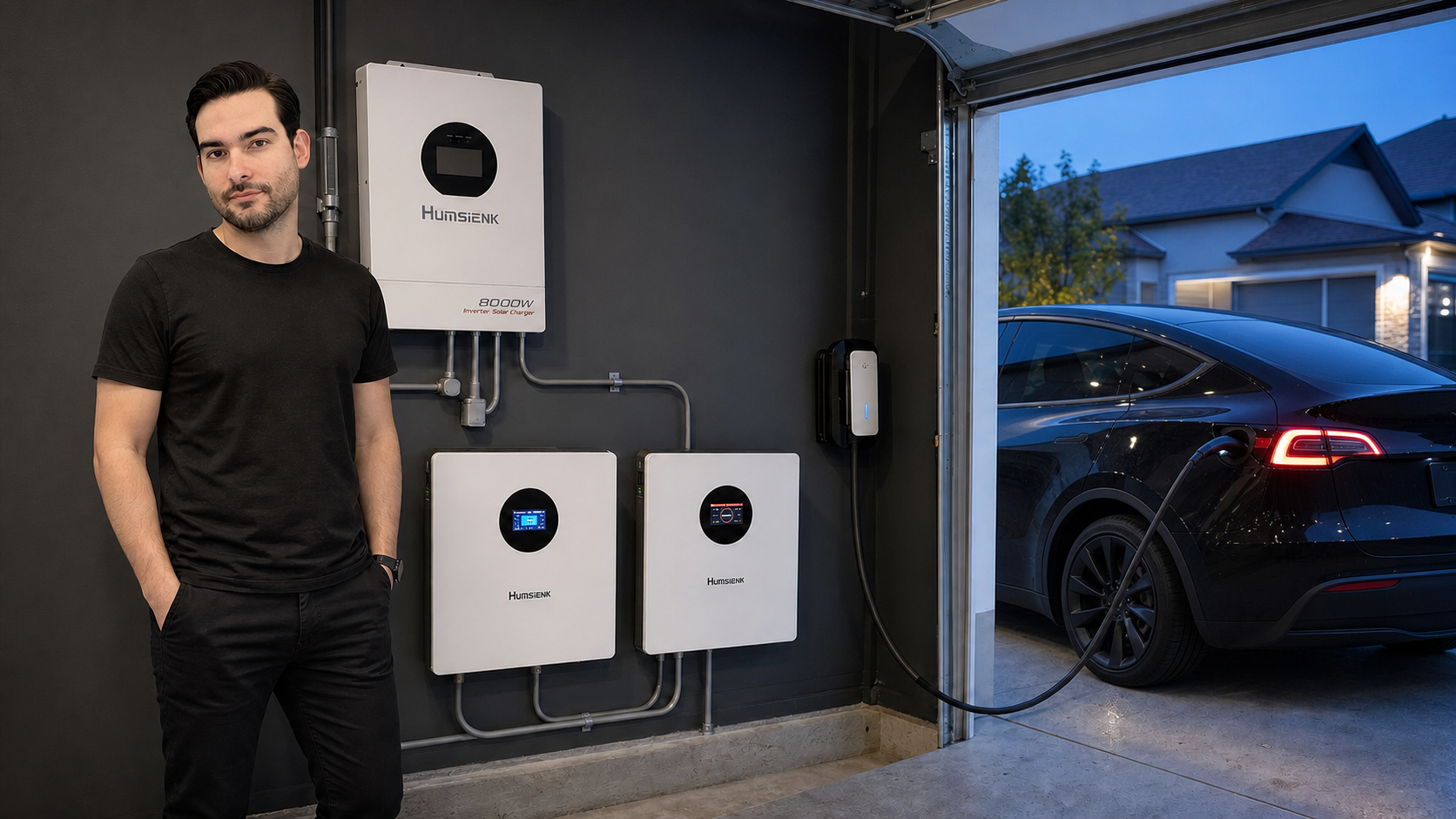
Before the inverter, the installation had to be safe
An off-grid system is not just a battery and an inverter. Between the energy source, inverter, and loads, it needs an intentional structure for distribution, isolation, transfer, protection, and measurement. I built a dedicated protection and distribution box so the test bench could support 120 V loads from either line to neutral and approximately 240 V between L1 and L2.
- Appropriately sized input and output protection
- Surge protection connected to the grounding system
- Voltage monitoring with a contactor
- Safe source transfer that prevents backfeed
- Live voltage, current, power, and energy measurement
We had 240 V, but the Tesla still refused to charge
The inverter started, L1 and L2 were present, and the meter showed approximately 240 V. The NEMA 14-50 EVSE was connected, but the Tesla would not accept power. The missing piece was not voltage. In this isolated configuration, neutral was floating relative to protective earth, so the vehicle's safety checks did not see the reference they expected.
The Humsienk includes an N to PE Connection setting related to establishing the required neutral and protective-earth relationship while the inverter operates as an independent source. Correcting that reference allowed the test vehicle to recognize the supply and begin charging.
The Tesla exposed the limit of one battery
The EVSE can request up to roughly 32 A at 240 V, which makes it an unusually useful controllable load. I started low and increased the current gradually. The system kept working until the test reached approximately 22 to 23 A, when the single battery protected itself and disconnected its output.
That result demonstrated the difference between energy and power. A battery rated near 5 kWh stores about five kilowatt-hours of energy, but its maximum continuous output still depends on the BMS, cells, state of charge, temperature, cables, connectors, and protective devices.
At 240 V and 22 A, the AC load is about 5.28 kW. Supplying roughly 5.5 kW from a 51 V battery requires around 108 A on the DC side before fully accounting for conversion losses and voltage variation. One battery had reached the practical point where its protection said enough.
The next step is a two-battery, 10 kWh bank
Adding a second Humsienk 5 kWh battery brings the planned bank to roughly 10 kWh and, just as importantly for this experiment, allows the discharge current to be shared across two packs when the bank is configured correctly.
The physical parallel connection requires the manufacturer's appropriate double-ended quick-connect cable. The cable I had was intended for a battery-to-inverter path, not the specific battery-to-battery daisy chain. Humsienk agreed to send the correct interconnect, so the full 10 kWh test remains paused until it arrives.
Power conductors are only half of the job. The batteries also need their communication chain, using LINK OUT from the master battery to LINK IN on the next unit. The inverter configuration must then reflect the installed bank while respecting the lowest current limit among the batteries, BMS, wiring, connectors, protective devices, and inverter DC input.
Will two batteries charge the Tesla at 32 A?
Removing one bottleneck only reveals the next one. Two batteries should provide more energy and greater combined discharge capability, but the inverter itself still has operating limits. A 32 A request at 240 V is approximately 7.68 kW before the rest of the garage is added, and the headline 8 kW rating should not be assumed to apply identically in every battery, bypass, and operating condition.
The Tesla is not the end goal and this is not presented as the most efficient way to charge an EV every day. It is the electrical dynamometer for the project. The charging current can be stepped through 10, 15, 20, 22, 24, and 32 A while I record output, runtime, temperature, protection behavior, inverter consumption, and the difference between one and two batteries.
Turning the complete garage into an off-grid workspace
After the high-power tests, the project shifts toward a more realistic use case: running the garage as a working space from the battery bank. The planned loads include lighting, fans, a monitor, laptop, phones, cameras, tool chargers, Starlink, a small freezer, and possibly portable air conditioning.
A reduced Tesla charging current combined with lights, Internet, computers, and cooling will resemble a small home operating through an outage far better than a single 100 W lamp. I also want to run a livestream where the camera, lights, computer, and Starlink connection are all powered by the system while viewers can see power, state of charge, and estimated runtime in real time.
A practical backup experiment for Florida
This installation also has a direct application in Florida during hurricane season. A long outage does not always require powering an entire house as if nothing happened. Internet, refrigeration, ventilation, lights, phones, computers, selected kitchen loads, and limited air conditioning can be prioritized around the available energy.
A modular battery bank makes those priorities measurable and expandable. The goal is to document the tradeoffs with real loads and real runtime instead of relying only on a specification sheet.
The next comparison is a golf-cart battery
A later experiment will connect a 48 or 51.2 V LiFePO₄ battery originally designed for a golf cart or light electric vehicle. Similar voltage and energy capacity do not make it automatically plug-and-play with a hybrid inverter. The battery can have its own protective BMS while lacking the CAN or RS485 protocol the Humsienk expects for closed-loop communication.
If its voltage range and charge and discharge limits are compatible, a conservative user-defined configuration may be possible. That would require carefully setting the chemistry, charging voltage, low-voltage cutoff, maximum current, and reconnection behavior so the inverter stays inside the battery's limits before the internal BMS is forced to intervene.
The comparison is bigger than raw capacity. A wall battery prioritizes residential integration, while a golf-cart pack is designed for high current in a compact, durable form. Price, connectors, communication, packaging, and the possibility of shipping the battery onward to Cuba all matter to the real audience for this test.
What this second mini series is really testing
The first installation taught me how the ecosystem works. This second series asks how far it can be pushed. It begins with protection and split-phase distribution, follows the floating-neutral diagnosis, measures the limit of one battery, builds toward a two-battery bank, and then repeats the same controlled load tests.
- One battery compared with two
- Approximately 5 kWh compared with 10 kWh
- Light everyday loads compared with an extreme EV load
- Published specifications compared with measured behavior
- Closed-loop residential battery communication compared with a manually configured golf-cart battery
10 kWh test update pending
At publication time I am still waiting for the double-ended quick-connect cable required to complete the power interconnection between the two Humsienk batteries. Every Tesla charging result currently described in this article comes from one battery of approximately 5 kWh. I will not invent the performance of the 10 kWh bank before testing it.
- Maximum stable Tesla charging current
- Maximum observed AC power
- Approximate DC power
- Starting and ending state of charge
- Temperature and behavior under load
- First protection or limiting component encountered
Energy without limits means learning every limit
The purpose is to create a space that can operate independently from the grid, but doing that responsibly requires knowing the limits of the battery, BMS, cables, protection, inverter, and the loads we actually need. I want to run the garage for hours, work from it, stream from it, and show exactly what happened when the system approached its limits.
A specification tells us what a product should do. This second mini series is designed to discover what the complete system can really do.
A 6% discount for viewers building their own system
As part of my Humsienk collaboration, the AMS Lab audience currently receives an exclusive 6% discount with code SHUFFLIN or through my referral link. That support helps fund the cables, protection devices, materials, and equipment used in future tests.